Hyaluronic Acid Molecular Weights: Does Size Matter in Skincare Efficacy?
Executive Summary
The commoditization of hyaluronic acid (HA) in the cosmetic industry has led to widespread consumer confusion. Often marketed as a universal hydration panacea, the efficacy of HA is intrinsically tied to a critical, frequently overlooked metric: its molecular weight. For formulation chemists, dermatologists, and astute consumers, understanding the dimensional science of hyaluronic acid is the key to differentiating between superficial moisturization and structural dermal repair.
The Misconception of a “One-Size-Fits-All” Molecule
Hyaluronic acid, a naturally occurring glycosaminoglycan in the human body, is celebrated for its capacity to bind up to 1,000 times its weight in water. However, HA is not a uniform ingredient. Its molecular size is measured in Daltons (Da) or kilodaltons (kDa), and this atomic mass dictates precisely how the molecule interacts with the skin’s biological architecture.
When skincare brands list “hyaluronic acid” on an ingredient panel without specifying its weight, they obscure the product’s actual function. The physiological impact of HA is entirely dependent on its ability—or inability—to breach the stratum corneum (the skin’s outermost barrier).
High Molecular Weight HA (HMW-HA): The Epidermal Shield
Size Classification: Generally > 1,000 kDa (1,000,000 Daltons)
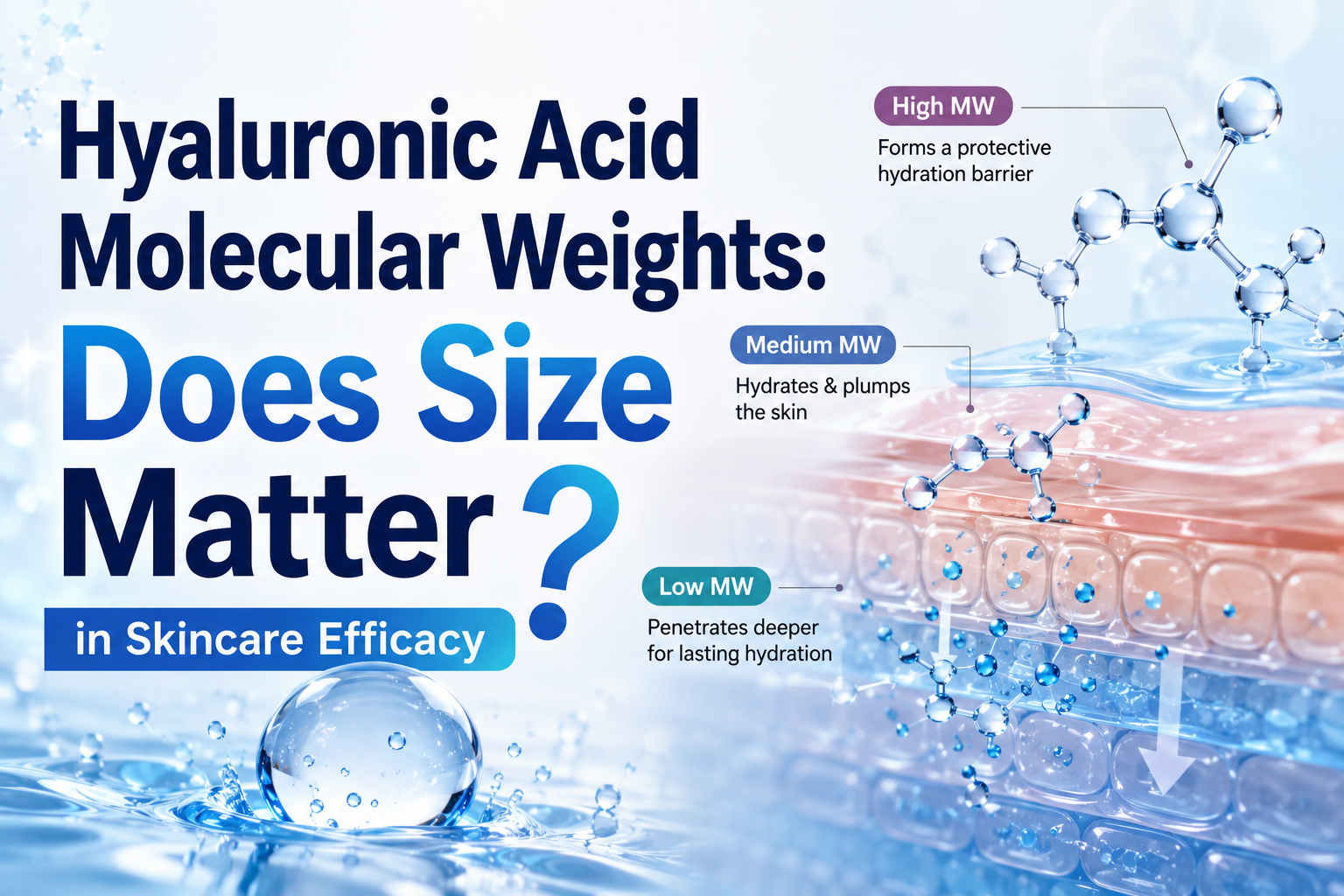
High molecular weight hyaluronic acid is structurally too large to penetrate the skin barrier. While this may sound like a detriment, it serves a vital physiological purpose. HMW-HA rests on the epidermal surface, creating a visco-elastic, breathable film.
Key Benefits:
- Mitigates TEWL: By forming a protective matrix, it dramatically reduces Transepidermal Water Loss (TEWL), locking in pre-existing moisture.
- Immediate Cosmetic Elegance: It smooths the skin’s micro-relief, providing an immediate, albeit temporary, plumping effect that diminishes the appearance of fine lines.
- Anti-Inflammatory Properties: Surface-level HA has been clinically shown to soothe erythema and support barrier repair in compromised skin.
Low Molecular Weight HA (LMW-HA): The Dermal Penetrator
Size Classification: 50 kDa to 1,000 kDa
To achieve hydration beyond the superficial layer, the molecule must be cleaved into smaller fragments. Low molecular weight HA is engineered to bypass the stratum corneum and enter the deeper layers of the epidermis.
Key Benefits:
- Structural Hydration: LMW-HA acts as an internal humectant, drawing moisture into the deeper epidermal layers to provide sustained hydration.
- Cellular Efficacy: Research indicates that HA within the 50-300 kDa range is highly effective at stimulating the skin’s endogenous (internal) production of hyaluronic acid and collagen.
- Long-Term Anti-Aging: By sustaining deep hydration, it improves skin elasticity and fundamentally addresses the structural deficits that cause deep-set wrinkles over time.
Ultra-Low Molecular Weight & Oligo-HA: The Cellular Catalyst
Size Classification: < 50 kDa
The frontier of HA technology lies in ultra-low molecular weights, often referred to as Oligo-hyaluronic acid. These microscopic fragments penetrate down to the dermis. However, this category requires sophisticated formulation.
Key Considerations:
- Deep Tissue Repair: Oligo-HA can trigger rapid tissue repair and profound hydration at the cellular level.
- The Pro-Inflammatory Caveat: Clinical literature suggests that HA fragments smaller than 20 kDa can occasionally trigger an inflammatory immune response, as the body may mistake these tiny fragments for degraded tissue requiring an immune reaction. Therefore, precise engineering and stabilization by the manufacturer are non-negotiable.
The Golden Standard: Multi-Molecular Formulation Strategy
So, does size matter? Unequivocally, yes. However, the optimal solution is not selecting one size over the other, but leveraging a synergistic matrix.
From a product development and efficacy standpoint, the “Golden Standard” in modern skincare is a multi-molecular weight formulation. By combining HMW, LMW, and Oligo-HA, a sophisticated serum can operate on multiple thermodynamic planes simultaneously:
- HMW seals the surface and prevents evaporation.
- LMW plumps the mid-epidermis and stimulates collagen.
- Oligo-HA initiates deep cellular repair.
Conclusion: The Bottom Line for Consumers and Industry Professionals
In the highly competitive landscape of cosmeceuticals, formulation transparency is becoming the ultimate currency. Moving forward, the efficacy of an HA product will not be judged merely by its inclusion of the ingredient, but by the strategic calibration of its molecular weights. For those seeking tangible, clinical-grade results—whether formulating a new product line or investing in a daily regimen—prioritizing multi-dimensional hyaluronic acid is a scientific imperative.