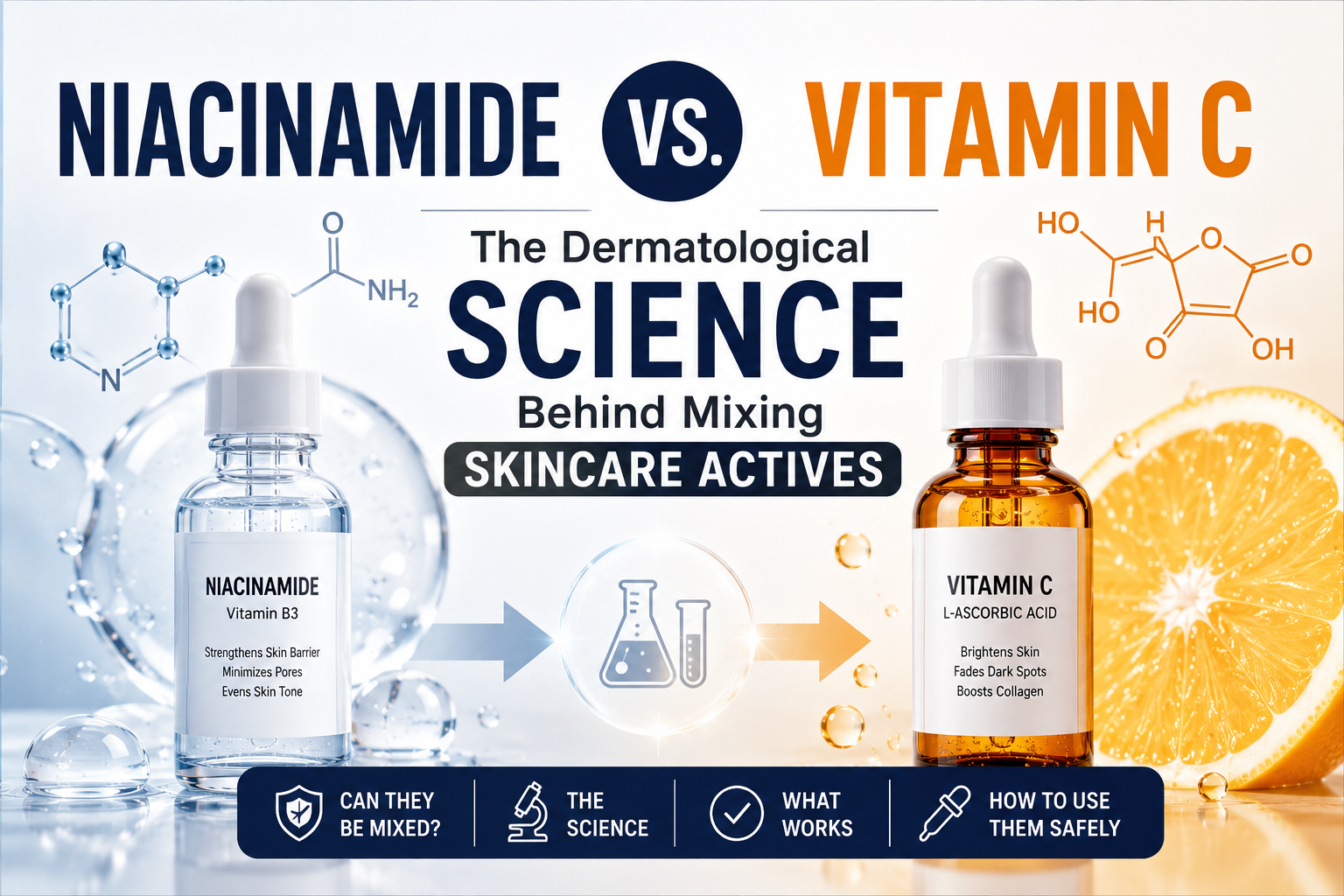
Niacinamide vs. Vitamin C: The Dermatological Science Behind Mixing Skincare Actives
Executive Summary
For decades, a pervasive myth has dominated the skincare industry: the assertion that Niacinamide (Vitamin B3) and Vitamin C (L-Ascorbic Acid) are mutually exclusive actives that neutralize each other when combined. This antiquated narrative has forced consumers and even some clinicians into rigid, bifurcated skincare routines. However, modern cosmetic chemistry and dermatological research have unequivocally debunked this paradigm. Not only can these two powerhouse antioxidants be used together, but when strategically integrated, their synergistic effects deliver a superior return on skincare investment, targeting photoaging, hyperpigmentation, and barrier dysfunction simultaneously.
The Genesis of the Incompatibility Myth
To understand the science, one must first dismantle the myth. The belief that these two ingredients are incompatible stems from a singular, outdated research study published in the 1960s.
In that study, researchers observed that combining pure Niacinamide and pure L-Ascorbic Acid caused a chemical reaction that produced nicotinic acid—a compound known to cause transient facial flushing (erythema). However, this reaction only occurred under extreme, non-physiological conditions: the ingredients were exposed to extraordinarily high temperatures for prolonged periods. Modern commercial skincare formulations are stabilized, structurally sophisticated, and stored at room temperature, making the spontaneous conversion to nicotinic acid practically impossible in a standard bathroom cabinet.
The Biochemical Profiles: Understanding the Actives
To appreciate their synergy, we must look at their individual mechanisms of action:
1. Vitamin C (L-Ascorbic Acid): The Protective Catalyst
- Function: A potent antioxidant that neutralizes free radicals generated by UV exposure and environmental pollutants.
- Clinical Efficacy: It is scientifically proven to inhibit tyrosinase (the enzyme responsible for melanin production) and stimulate fibroblast activity for collagen synthesis.
- Formulation Challenge: Pure L-Ascorbic Acid is notoriously unstable and requires a highly acidic environment (pH 2.5 to 3.5) to permeate the stratum corneum.
2. Niacinamide (Vitamin B3): The Barrier Architect
- Function: A highly stable, water-soluble vitamin that facilitates cellular repair and metabolic function.
- Clinical Efficacy: It regulates sebum production, diminishes the appearance of enlarged pores, prevents the transfer of melanosomes to keratinocytes (curbing dark spots), and boosts ceramide production to fortify the lipid barrier.
- Formulation Challenge: Niacinamide is exceptionally robust and formulates best at a near-neutral pH (around 5.0 to 6.0).
The Molecular Interaction: What Actually Happens?
The crux of the hesitation lies in the pH discrepancy. Critics argue that mixing the low-pH Vitamin C with the neutral-pH Niacinamide raises the pH of the Vitamin C, neutralizing its efficacy.
When these two ingredients are combined in a liquid state, they form a temporary, weak molecular bond known as Niacinamide Ascorbate. Visually, the product may adopt a slight yellow tint. Historically, this was misinterpreted as the Vitamin C oxidizing and degrading. In reality, Niacinamide Ascorbate is simply a coupled complex. Once applied to the skin, the physiological environment breaks this weak bond, allowing both the Niacinamide and the L-Ascorbic Acid to absorb and perform their distinct biological functions without interference.
Strategic Integration: Best Practices for Formulation and Application
For industry professionals developing regimens, or informed consumers looking to optimize their routines, the combination of these actives requires strategic execution to maximize efficacy and minimize any remote risk of irritation.
- Sequential Layering (The pH Protocol): When using separate serums, apply the active with the lowest pH first. Apply the L-Ascorbic Acid to clean, dry skin. Allow it to absorb for 60 to 90 seconds, letting the skin’s pH begin to equilibrate, before applying the Niacinamide serum.
- Leveraging Vitamin C Derivatives: The compatibility debate focuses exclusively on pure L-Ascorbic Acid. If a formulation utilizes advanced, stable Vitamin C derivatives—such as Tetrahexyldecyl Ascorbate (THD), Sodium Ascorbyl Phosphate (SAP), or Magnesium Ascorbyl Phosphate (MAP)—there is zero risk of pH conflict. These derivatives operate effectively at the same neutral pH as Niacinamide.
- Pre-Formulated Complexes: The safest and most elegant solution is utilizing a cosmetically engineered formula that includes both ingredients. Formulation chemists employ encapsulation technology and advanced emulsifiers to suspend both actives stably in a single matrix, guaranteeing efficacy without the guesswork.
Conclusion: The Synergistic Future of Skincare
In the evidence-based landscape of modern dermatology, isolating Niacinamide from Vitamin C is an unnecessary restriction. Together, they offer a comprehensive, multi-pathway approach to skin health: Vitamin C prevents oxidative damage and inhibits melanin production at the source, while Niacinamide blocks the transport of any remaining pigment and repairs the physical barrier. For those pursuing a high-performance skincare strategy, combining these clinical heavyweights is not just permissible—it is highly recommended.