
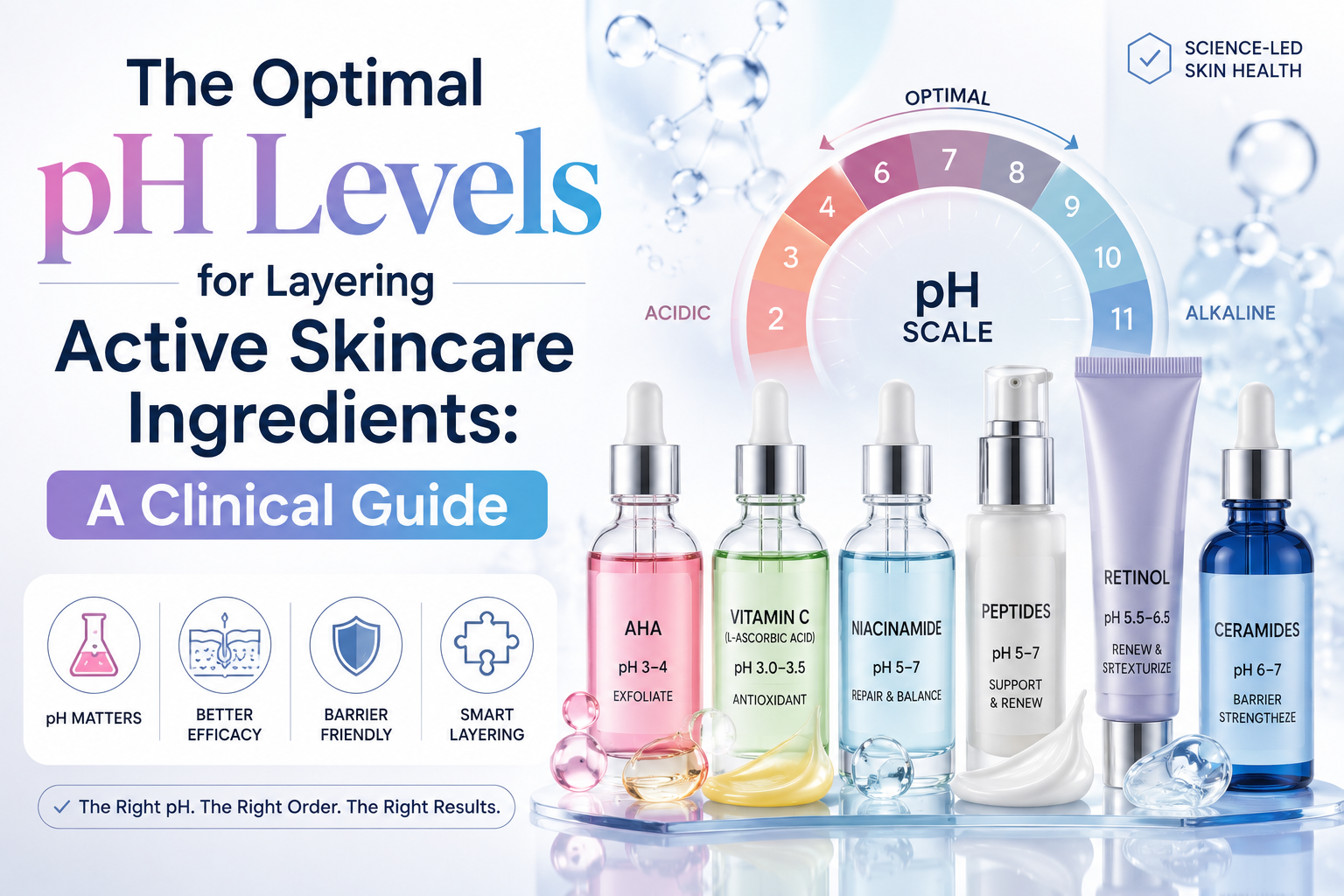
The Optimal pH Levels for Layering Active Skincare Ingredients: A Clinical Guide
In the realm of high-performance skincare, selecting premium ingredients is only half the equation. The true determinant of clinical efficacy lies in bioavailability—the degree to which an active molecule can penetrate the stratum corneum and enact cellular change.
For modern professionals investing in medical-grade skincare, understanding the chemistry of application is non-negotiable. The most critical, yet frequently overlooked, variable in this equation is pH (potential of hydrogen). Applying highly unstable actives at the wrong pH, or layering incompatible molecules sequentially, not only neutralizes their efficacy but can also induce severe barrier dysfunction.
Here is the definitive clinical guide to deconstructing the pH of active ingredients and engineering a scientifically sound layering protocol.
The Baseline: Understanding the Skin’s Acid Mantle
Human skin is inherently acidic. The outermost layer of the epidermis is protected by the acid mantle, a fine bio-film composed of sebum, sweat, and lactic acid.
In optimal conditions, the skin’s baseline pH hovers between 4.7 and 5.5. This mildly acidic environment is crucial for two reasons:
- It creates an inhospitable environment for pathogenic bacteria (such as C. acnes).
- It optimizes the function of epidermal enzymes responsible for synthesizing ceramides and facilitating natural desquamation (cell shedding).
When we apply active ingredients, we are temporarily altering this delicate ecosystem. To maximize efficacy without triggering chronic inflammation, topicals must be applied in harmony with their formulation chemistry.
Decoding Active Ingredients by Optimal pH
Different molecular compounds require specific acidic or neutral environments to remain stable and penetrate the lipid barrier.
| Active Ingredient | Primary Function | Optimal pH Range | Chemical Behavior & Considerations |
|---|---|---|---|
| L-Ascorbic Acid (Vitamin C) | Antioxidant, collagen synthesis | 2.5 – 3.5 | Highly unstable. Requires a highly acidic environment to penetrate the skin. At a pH above 3.5, the molecule oxidizes rapidly, rendering it ineffective. |
| BHA (Salicylic Acid) | Lipophilic exfoliation (pore clearing) | 3.0 – 4.0 | Oil-soluble. Must remain acidic to exert keratolytic (exfoliating) effects and dissolve sebum within the follicle. |
| AHA (Glycolic/Lactic Acid) | Hydrophilic exfoliation (surface resurfacing) | 3.0 – 4.0 | Water-soluble. Low pH is required to break the bonds (desmosomes) between dead skin cells. |
| Niacinamide (Vitamin B3) | Barrier repair, sebum regulation | 5.0 – 7.0 | Highly stable and barrier-friendly. If exposed to highly acidic environments, it can convert into nicotinic acid, causing temporary facial flushing and erythema. |
| Retinoids (Retinol/Tretinoin) | Cellular turnover, anti-aging | 5.5 – 6.0 | Operates optimally at the skin’s natural pH. Highly acidic environments can destabilize the conversion process of retinol to retinoic acid. |
| Peptides & Ceramides | Structural repair, hydration | 5.5 – 7.0 | Operates close to a neutral pH to mimic and repair the biological skin barrier. |
The Clinical Protocol: Strategic Layering Rules
The fundamental rule of skincare layering is often cited as “thinnest to thickest texture.” However, from a biochemical perspective, the hierarchy must be dictated by pH: lowest to highest.
Rule 1: Acidic Actives Go First
After cleansing (which briefly elevates the skin’s pH), the skin must be immediately treated with your most acidic, pH-dependent ingredients. L-Ascorbic Acid should be applied to bare, dry skin first. This ensures the molecule enters the dermis before the environment is neutralized by heavier creams.
Rule 2: The Importance of the “Wait Time”
Chemical reactions take time. If you apply a highly acidic Vitamin C serum (pH 3.0) and immediately follow it with Niacinamide (pH 6.0), you prematurely neutralize the acid, drastically reducing the efficacy of the Vitamin C and potentially causing a flushing reaction from the B3.
- The Solution: Allow highly acidic treatments (Vitamin C, AHAs, BHAs) to absorb for 15 to 20 minutes before applying the next layer. This allows the skin’s pH to naturally begin its reset process.
Rule 3: Separate Conflicting Actives
To optimize ROI and minimize the risk of Transepidermal Water Loss (TEWL), it is often best to separate highly active ingredients into distinct routines rather than attempting to layer them all at once.
- AM Protocol (Protection): L-Ascorbic Acid (pH 3.0) → Moisturizer → SPF.
- PM Protocol (Correction): Exfoliating Acids (pH 3.5) OR Retinoids (pH 5.5) → Niacinamide/Ceramides (pH 6.0). Never layer chemical exfoliants and retinoids in the same application, as the cumulative damage to the acid mantle outweighs the benefits.
The Bottom Line
Effective skincare is applied biochemistry. By strategically aligning the application of your active ingredients with their optimal pH parameters, you prevent formulation neutralization, mitigate inflammatory responses, and ensure that your investment in clinical-grade skincare delivers measurable, physiological results.