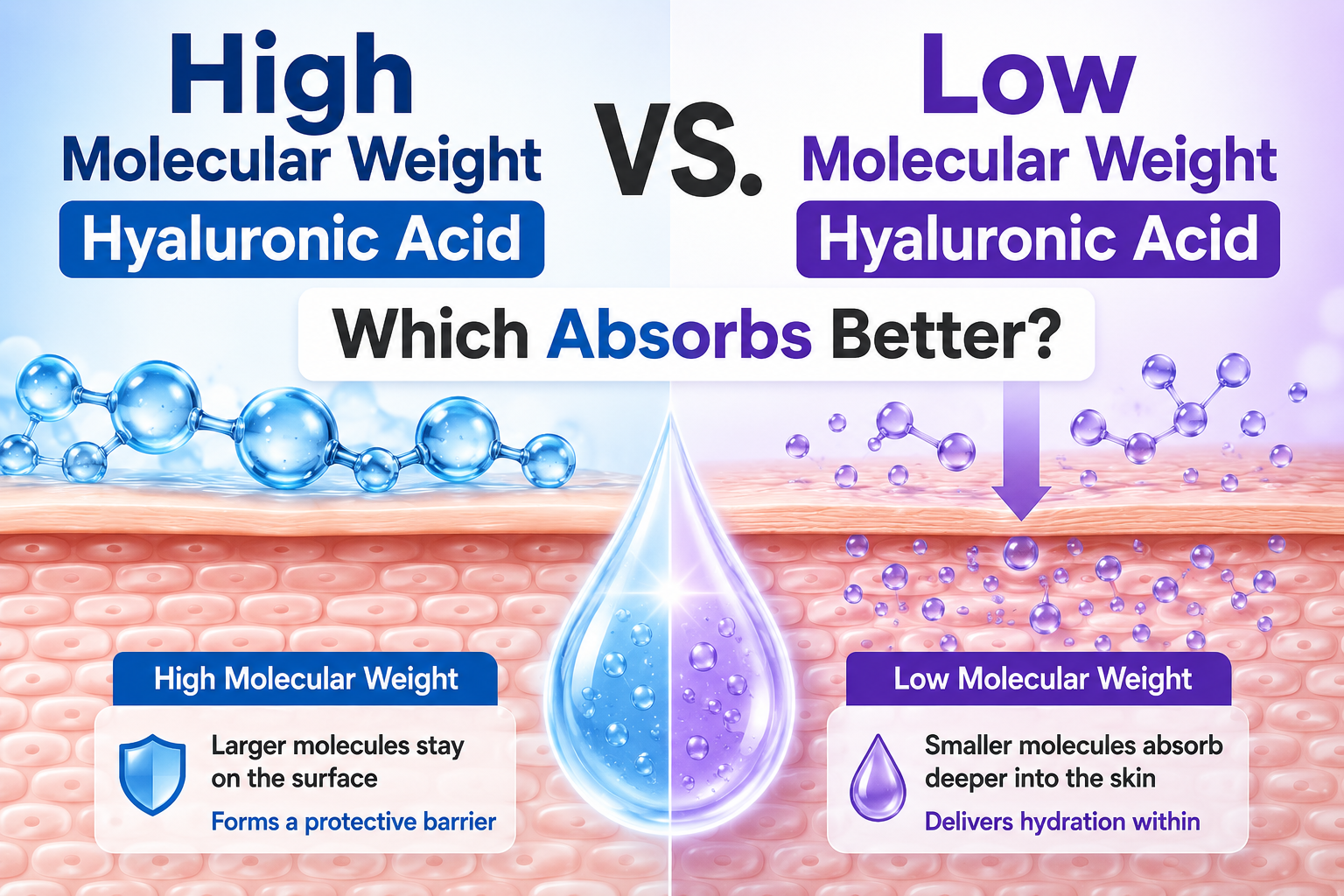
High vs. Low Molecular Weight Hyaluronic Acid: Which Absorbs Better?
In the modern skincare landscape, Hyaluronic Acid (HA) is no longer a novel ingredient; it is a fundamental baseline for hydration. However, as consumer education deepens and formulation science advances, the conversation has shifted from the mere presence of HA to its structural specifications—specifically, its molecular weight. For cosmetic chemists, dermatologists, and informed consumers, the distinction between high and low molecular weight hyaluronic acid is critical in determining a product’s efficacy, absorption profile, and ultimate market value.
The Mechanics of High Molecular Weight Hyaluronic Acid (HMW HA)
High molecular weight hyaluronic acid typically ranges from 1,000 to 1,500 kilodaltons (kDa) and above. Biologically, this closely mimics the HA naturally produced within the human body.
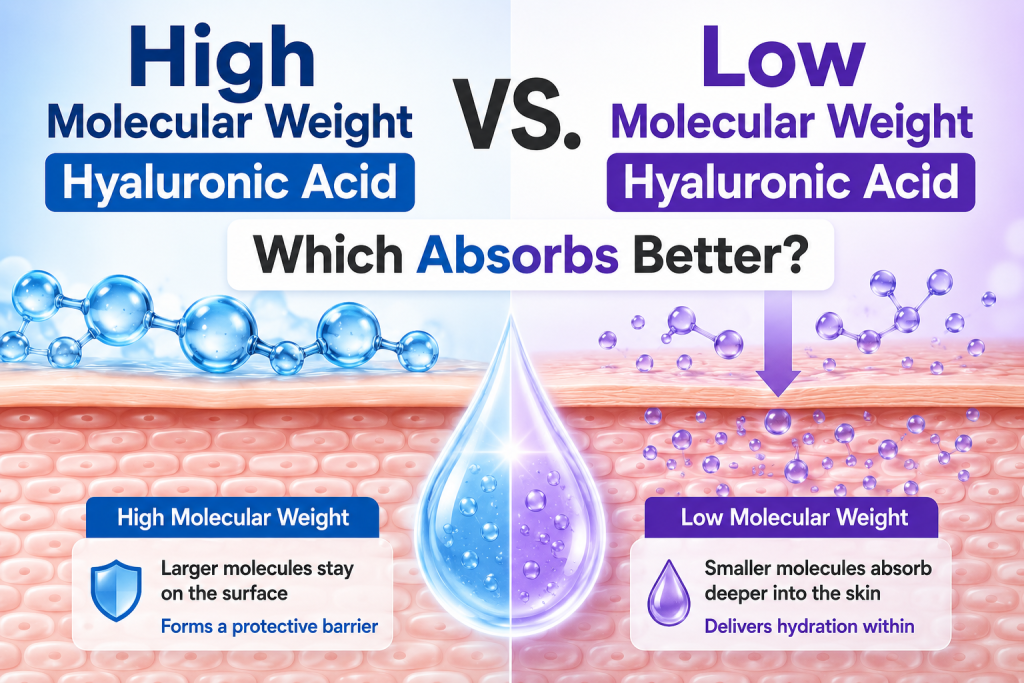
Due to its large molecular size, HMW HA does not absorb deeply into the skin. Instead, it forms a viscoelastic, permeable film on the outermost layer of the stratum corneum.
- Primary Benefit: It acts as a powerful humectant shield. By drawing moisture from the environment and binding it to the skin’s surface, HMW HA provides immediate, visible plumping and smoothing effects.
- Barrier Protection: More importantly, it significantly reduces Transepidermal Water Loss (TEWL), ensuring that the skin’s innate hydration remains locked in.
While its absorption rate is functionally zero, its surface-level utility is indispensable for immediate aesthetic improvement and barrier defense.
The Penetration Dynamics of Low Molecular Weight Hyaluronic Acid (LMW HA)
Low molecular weight hyaluronic acid (often categorized as 50 kDa or lower, sometimes venturing into ultra-low nano weights) is fragmented through hydrolysis to ensure a radically smaller molecular footprint.
Unlike its larger counterpart, LMW HA is specifically engineered to absorb. It successfully bypasses the skin’s initial barrier, penetrating into the deeper layers of the epidermis.
- Deep Cellular Hydration: Once absorbed, LMW HA stores moisture within the deeper skin tissues, providing sustained, long-term hydration that effectively plumps the skin from the inside out.
- The Inflammatory Caveat: From a clinical perspective, size matters—but smaller is not infinitely better. Research indicates that ultra-low molecular weight HA (under 20 kDa) can inadvertently trigger an inflammatory response, as the body may interpret these extreme micro-fragments as a sign of tissue damage. Formulators must carefully calibrate the Dalton weight to maximize absorption without compromising skin integrity.
The Verdict: Which Absorbs Better?
From a strict pharmacokinetic standpoint, Low Molecular Weight Hyaluronic Acid unequivocally absorbs better. Its fractionated size allows it to penetrate the epidermal barrier, whereas High Molecular Weight HA remains entirely on the surface.
However, asking which absorbs better is solving only half the equation. The more pertinent question for industry professionals is: Which delivers a superior dermatological outcome? Deep absorption (LMW) provides structural, lasting moisture, but surface retention (HMW) is mandatory to prevent that moisture from evaporating into the environment.
Formulating for Success: The Multi-Molecular Approach
In contemporary dermatological science, prioritizing one molecular weight over the other is an outdated strategy. The most clinically effective and commercially successful products utilize a multi-molecular (or broad-spectrum) formulation.
By combining both high and low molecular weights, premium skincare formulations achieve a synergistic effect:
- LMW HA penetrates deeply to repair and hydrate at the cellular level.
- HMW HA seals the surface, immediately reducing the appearance of fine lines and halting TEWL.
For brands and consumers aiming for optimal efficacy, a multi-molecular approach is the definitive standard. Understanding the specific mechanics of HA absorption allows for smarter purchasing decisions, superior product development, and ultimately, far superior clinical results.