How to Safely Incorporate Exfoliating Acids (AHA/BHA/PHA) into Your Routine
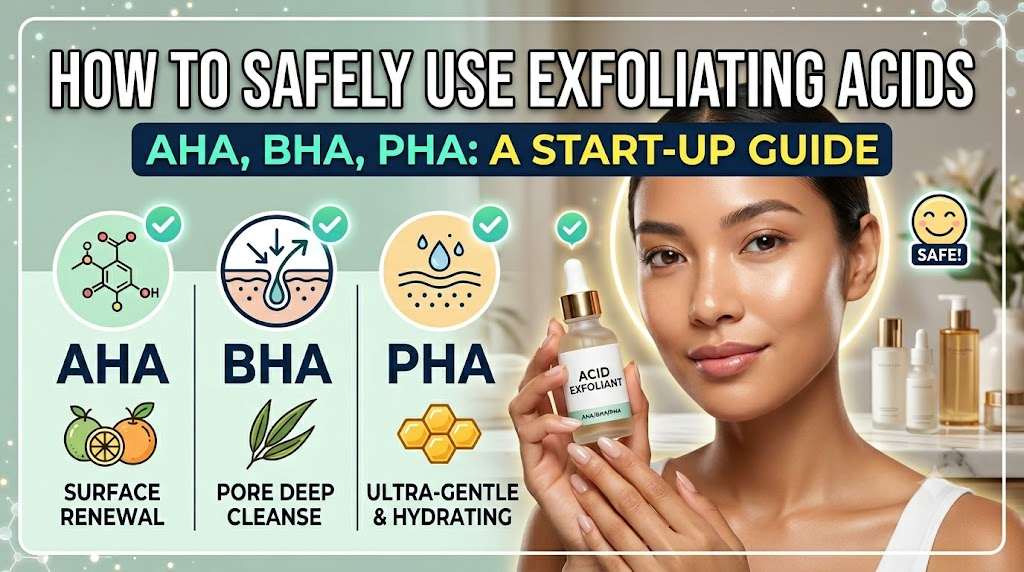
The modernization of cosmetic chemistry has effectively phased out aggressive, mechanical physical scrubs in favor of chemical desquamation. Hydroxy acids—Alpha-Hydroxy Acids (AHAs), Beta-Hydroxy Acids (BHAs), and Poly-Hydroxy Acids (PHAs)—have become foundational pillars in clinical skincare, celebrated for their ability to treat hyperpigmentation, accelerate cellular turnover, and clear acneic congestion.
However, the rapid democratization of high-concentration active ingredients has led to widespread misuse. Without a structured, scientifically validated implementation protocol, these potent chemical agents can cause severe barrier disruption, chronic inflammation, and hyperpigmentation.
For industry innovators and clinical practitioners, educating the market on the safe integration of these chemical exfoliants is critical to maximizing consumer retention and product safety.
1. The Chemical Blueprint: Understanding AHA, BHA, and PHA
To safely integrate hydroxy acids into a daily regimen, one must understand how their distinct molecular structures govern their behavior on the skin.
[Hydroxy Acids]
       │
       ├─► Alpha-Hydroxy Acids (AHA)  ──► Water-soluble ──► Epidermal Resurfacing
       │
       ├─► Beta-Hydroxy Acids (BHA)   ──► Lipid-soluble ──► Intra-pore Cleansing
       │
       └─► Poly-Hydroxy Acids (PHA)   ──► Large Molecule ──► Ultra-gentle Surface Exfoliation
Alpha-Hydroxy Acids (AHAs): Epidermal Resurfacing
Common examples include Glycolic Acid (derived from sugar cane) and Lactic Acid (derived from sour milk).
- Mechanism: AHAs are water-soluble organic carboxylic acids. They target the stratum corneum by cleaving ionic bonds between corneocytes (desmosomes), inducing uniform desquamation.
- Characteristics: Glycolic acid has the smallest molecular weight among AHAs, allowing it to penetrate deeply and rapidly, which makes it highly effective but carries a higher risk of irritation. Lactic acid possesses a larger molecular structure and acts as a natural humectant, making it inherently more tolerable.
Beta-Hydroxy Acids (BHAs): Lipophilic Pore Cleansing
The primary BHA used in skincare is Salicylic Acid.
- Mechanism: Unlike AHAs, Salicylic Acid is oil-soluble (lipophilic). This allows it to bypass surface lipids, penetrate deep into the pilosebaceous unit (pores), and dissolve sebum and cellular debris.
- Characteristics: BHA features potent anti-inflammatory and antimicrobial properties, making it the gold standard for treating acne vulgaris, comedones, and congested skin.
Poly-Hydroxy Acids (PHAs): Next-Generation Multi-Taskers
Common examples include Gluconolactone and Lactobionic Acid.
- Mechanism: PHAs are often considered the next generation of AHAs. They possess multiple hydroxyl groups, which gives them a significantly larger molecular weight.
- Characteristics: Because of their structural bulk, PHAs penetrate the skin slowly and superficially, entirely eliminating the stinging sensations associated with traditional acids. Furthermore, their molecular structure functions as a powerful humectant that attracts water, making them ideal for compromised or hyper-sensitive skin types (such as rosacea or eczema).
2. The Science of Efficacy: pH, pKa, and the Free Acid Percentage
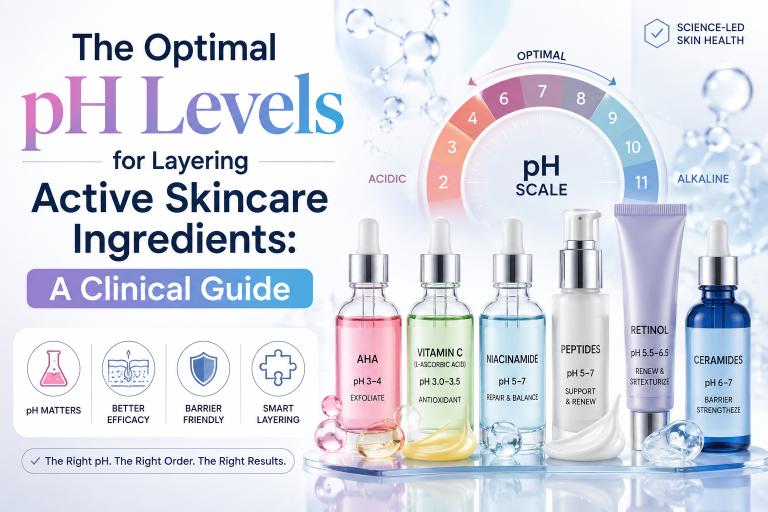
A common misconception in the skincare market is that ingredient concentration alone determines potency. In reality, the efficacy and irritation potential of a hydroxy acid are strictly governed by the pH of the final formulation relative to the acid’s pKa (acid dissociation constant).
The relationship is calculated using the Henderson-Hasselbalch equation:
pH=pKa+log([HA][A−])
Where [HA] represents the active, un-ionized free acid capable of penetrating the skin’s lipid barrier, and [A−] represents the ionized, salt form which cannot easily penetrate.
The Formulation Threshold: If a formulation’s pH is significantly higher than the ingredient’s pKa, the acid ionizes, rendering it cosmetically elegant but biologically inactive. Conversely, if the pH is too low (below 3.5), the free acid percentage spikes dangerously, causing immediate tissue irritation and chemical burns. The ideal therapeutic sweet spot for consumer formulations rests between a pH of 3.5 and 4.0.
3. The Clinical Integration Protocol: Safe Implementation
To achieve clinical results without compromising the skin barrier, a strategic framework must be applied when introducing these acids into a personal or patient regimen.
Phase 1: Micro-Dosing and Frequency Scaling
The skin must undergo a period of acclimation to avoid barrier shock.
- The Step-Up Approach: Introduce a single acid molecule once or twice per week at a low concentration (e.g., 5% Lactic Acid or 1% Salicylic Acid).
- The Chronological Buffer: Allow 48 to 72 hours between applications to assess the skin for delayed hypersensitivity or micro-peeling before increasing frequency.
Phase 2: Strategic Elimination of Chemical Cross-Reactivity
A major driver of barrier failure is the concurrent use of incompatible active ingredients.
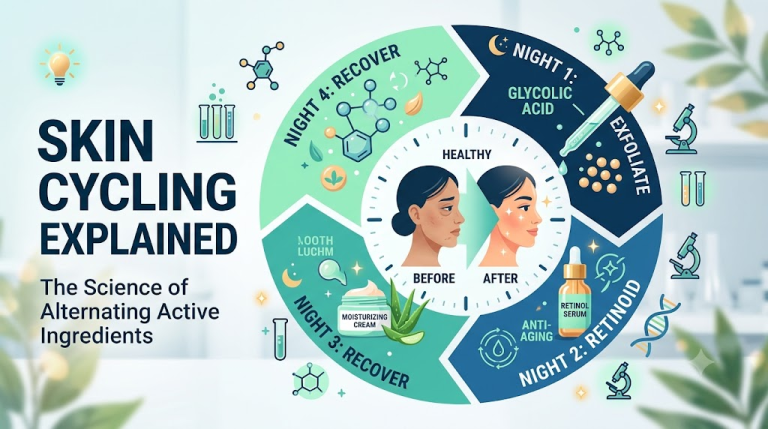
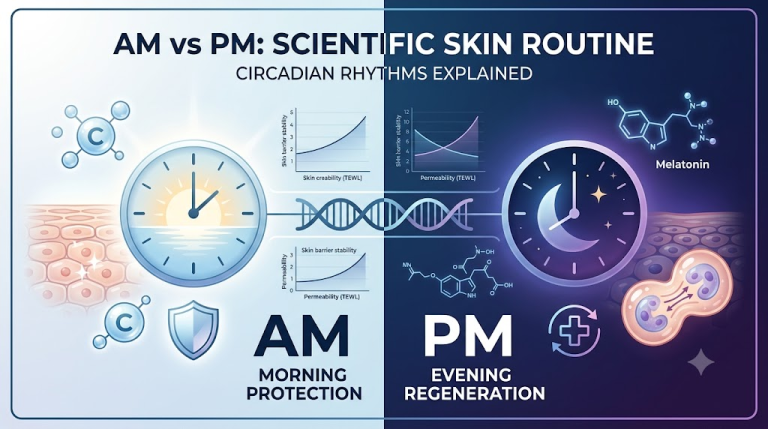
- The Retinoid Conflict: Hydroxy acids should never be layered in the same application window as Retinoids (Retinol, Tretinoin). Doing so overwhelms epidermal processing, triggering immediate contact dermatitis. Instead, utilize day/night alternation (AHAs in the AM, Retinoids in the PM) or implement a Skin Cycling protocol.
- The Vitamin C Paradox: L-Ascorbic Acid requires a low pH to penetrate the skin. Layering it simultaneously with an AHA can destabilize both formulas.
Phase 3: The Post-Acid Neutralization Matrix
Whenever an exfoliating acid is applied, it must be followed by a restorative lipid layer once the acid has self-neutralized or dried. Formulators recommend following an acid treatment with a barrier-repair cream rich in Ceramides, Squalane, and Panthenol to immediately counteract any induced transepidermal water loss.
4. Hydroxy Acid Comparative Matrix
| Feature | Alpha-Hydroxy Acid (AHA) | Beta-Hydroxy Acid (BHA) | Poly-Hydroxy Acid (PHA) |
|---|---|---|---|
| Solubility | Water-soluble | Oil-soluble (Lipophilic) | Water-soluble |
| Primary Site of Action | Epidermal Surface | Deep inside the Pore | Superficial Stratum Corneum |
| Target Skin Concerns | Hyperpigmentation, Fine lines, Dullness | Acne, Congestion, Excess Sebum | Sensitive skin aging, Dehydration |
| Molecular Size | Small (Deep penetration) | Medium | Large (Slow, shallow penetration) |
| Irritation Potential | Moderate to High | Low to Moderate | Exceptionally Low |
Conclusion: Strategic Mastery of Chemical Desquamation
Exfoliating acids are among the most transformative tools in modern skincare, but their power requires respect for the underlying biophysics of the skin barrier.
For skincare brands and medical practitioners, true market differentiation lies in moving away from high-percentage marketing claims and toward intelligent, bio-compatible delivery systems. By respecting the chemical limitations of pKa, prioritizing larger molecular profiles like PHAs for sensitive skin, and enforcing strict recovery protocols, consumers can safely unlock the full therapeutic potential of chemical exfoliation without compromising long-term skin health.