A Scientific Morning vs. Evening Routine: Circadian Rhythms of the Skin
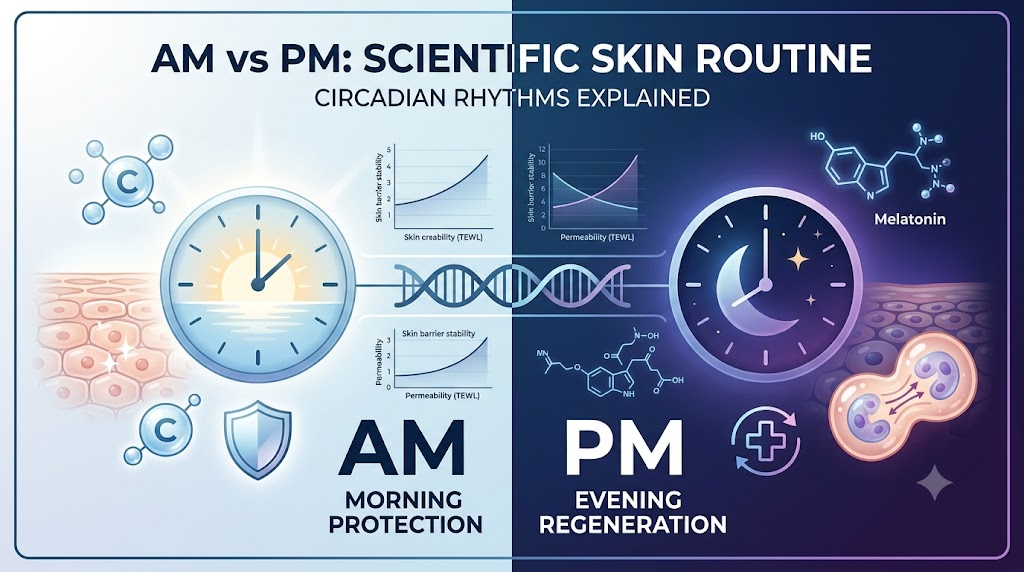
In the landscape of modern dermatology and premium product formulation, the traditional division of skincare into “day” and “night” products has frequently been dismissed as a mere marketing contrivance. However, breakthroughs in chronobiology—the study of biological rhythms—reveal that this temporal division is rooted in deep cellular science.
The skin is not a static shield; it is a dynamic, highly synchronized organ regulated by a microscopic internal clock. Every cutaneous cell operates on a 24-hour cycle dictated by circadian rhythms and controlled by specific master clock genes (CLOCK and BMAL1). Consequently, the skin’s biological priorities alter radically depending on the position of the sun.
For brand strategists, cosmetic chemists, and clinical practitioners, understanding these precise biological shifts is essential to maximizing the bioavailability and clinical efficacy of topically applied ingredients.
1. The Chronobiology of the Skin: A Dual-Phase System
To engineer an optimized routine, we must first analyze how the fundamental parameters of the skin barrier fluctuate across a 24-hour matrix.
[08:00 AM - Peak Cortisol] ──► Maximized Sebum Production + Peak Barrier Defenses
                                      │
                         (Environmental UV & Pollution Exposure)
                                      │
[11:00 PM - Peak Melatonin] ─► Accelerated Mitosis + High Permeability (Elevated TEWL)
The Daytime State: Environmental Defense
During daylight hours, the skin is locked in a hyper-vigilant defense mode. Under the influence of rising cortisol levels, sebum production peaks to bolster the acid mantle, and the skin increases its production of endogenous antioxidant enzymes to combat oxidative stress from Ultraviolet (UV) radiation and environmental pollution.
The Nighttime State: Metabolic Regeneration
Conversely, as darkness falls, the body releases melatonin—a potent endogenous antioxidant that orchestrates cellular repair. During this phase, cell division (mitosis) in the basal layer of the epidermis spikes, reaching its maximum velocity between 11:00 PM and 2:00 AM.
The Structural Vulnerability: Concurrently, Transepidermal Water Loss (TEWL) peaks at night. The skin barrier becomes temporarily more permeable, its surface temperature rises, and its pH drops. This creates a unique double-edged sword: the skin is highly receptive to topically applied active ingredients, but it is also exceptionally prone to dehydration and irritation.
2. The Morning Strategy: Neutralizing Environmental Aggressors
Because the skin’s morning objective is defense, a scientifically sound AM routine must act as an impenetrable environmental shield.
- The Antioxidant Network: Exposure to UV rays and particulate matter generates Reactive Oxygen Species (ROS), which degrade collagen and induce premature senescence. The cornerstone of a morning routine is a highly bioavailable antioxidant cocktail, most notably L-Ascorbic Acid (Vitamin C) synergized with Ferulic Acid and Tocopherol (Vitamin E). This combination neutralizes free radicals before they can damage DNA.
- Advanced Photoprotection: Sunscreen remains the ultimate anti-aging intervention. Modern AM formulations require stable, broad-spectrum UV filters combined with anti-pollution matrix polymers that physically inhibit particulate matter from adhering to the stratum corneum.
- Humectant Optimization: Because sebum production peaks naturally in the morning, daytime hydrators should utilize lightweight, non-occlusive humectants—such as low-molecular-weight Hyaluronic Acid and Glycerin—to retain water without overloading the lipid pathways.
3. The Evening Strategy: Maximizing Cellular Proliferation
The nocturnal phase presents an unparalleled window of opportunity. The increased permeability of the skin barrier means that heavy, complex macromolecules can penetrate deeper into the epidermis than they would during the day.
- Retinoid Optimization: Retinoids (Retinol, Retinal, Tretinoin) are inherently photolabile, breaking down rapidly under UV light. Therefore, they belong exclusively in the evening. Furthermore, since retinoids accelerate cellular turnover, introducing them at night aligns perfectly with the skin’s natural midnight mitotic spike.
- Biomimetic Barrier Reconstruction: To counteract the natural evening spike in TEWL, the final step of a PM routine requires structured, occlusive emollient matrices. Formulations must deliver the vital structural lipids—Ceramides, Cholesterol, and Fatty Acids—to artificially patch the permeable overnight barrier, sealing in moisture while cellular remodeling occurs underneath.
- Peptide Signaling: Cell-signaling peptides (such as Copper Peptides and Matrixyl) function best at night, directly assisting the skin’s upregulated repair mechanisms in synthesizing fresh extracellular matrix proteins.
4. Chronobiological Comparative Matrix
| Cutaneous Parameter | Morning State (AM) | Evening State (PM) |
|---|---|---|
| Primary Biological Mode | Protection & Shielding | Repair & Regeneration |
| Cellular Proliferation Rate | Low | High (Peaks between 11 PM – 2 AM) |
| Transepidermal Water Loss | Minimum (Barrier is highly stable) | Maximum (Barrier is highly permeable) |
| Sebum Production | Peak levels | Minimal levels |
| Primary Target Actives | Vitamin C, E, Ferulic Acid, UV Filters | Retinoids, Peptides, Ceramides, AHAs |
Conclusion: Chrono-Cosmetics as the New Competitive Frontier
The application of circadian science to skincare—often referred to as Chrono-Cosmetics—represents a major leap forward from generalized cosmetic blending. By matching the biochemical mechanism of an active ingredient to the exact hour the skin is primed to utilize it, we unlock exponential gains in clinical efficacy while mitigating the risk of cutaneous irritation.
For brand innovators and product developers, this represents a highly lucrative trajectory. The future of product formulation lies in creating interconnected, time-stamped product ecosystems that respect the body’s circadian clockwork. Embracing the science of timing is no longer an optional refinement; it is the definitive future of high-performance, clinical skincare.