The Biochemistry of Retinol: How It Accelerates Cell Turnover
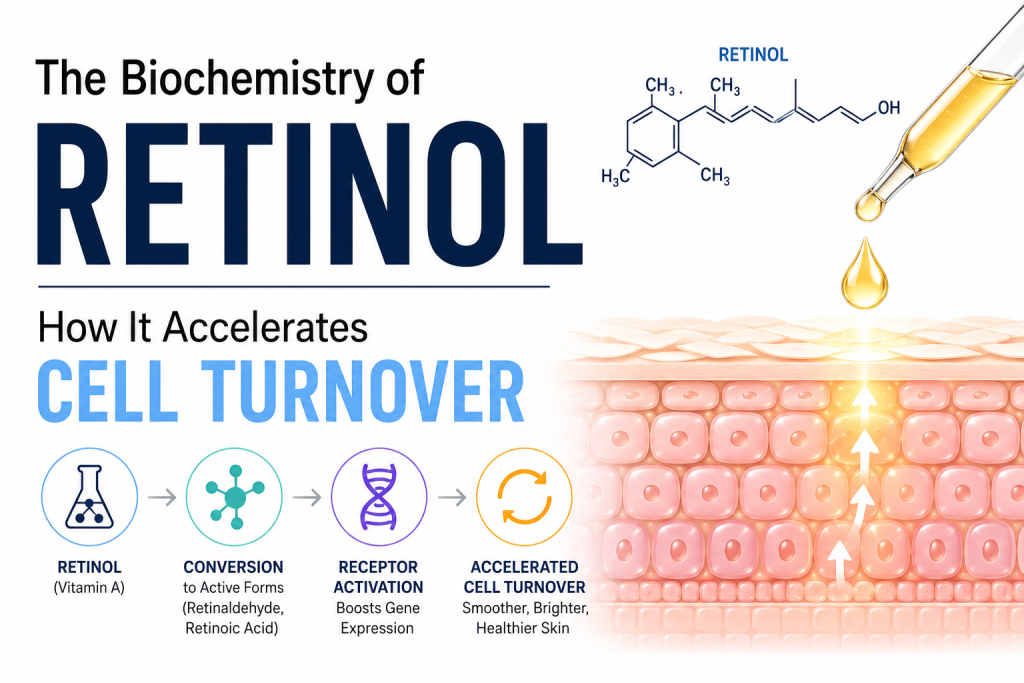
In the saturated market of clinical skincare, hyperbole often overshadows factual efficacy. However, when evaluating the return on investment (ROI) of active ingredients, one compound consistently remains the gold standard: Retinol.
For professionals and consumers seeking evidence-based results, understanding retinol requires looking past marketing claims and examining its core mechanism of action. The true power of retinol does not lie in surface-level moisturization; it lies in its ability to reprogram skin behavior at the cellular level. This column dissects the biochemistry of retinol and the specific metabolic pathways that drive cellular renewal.
1. The Retinoid Conversion Pathway: A Prerequisite for Activation
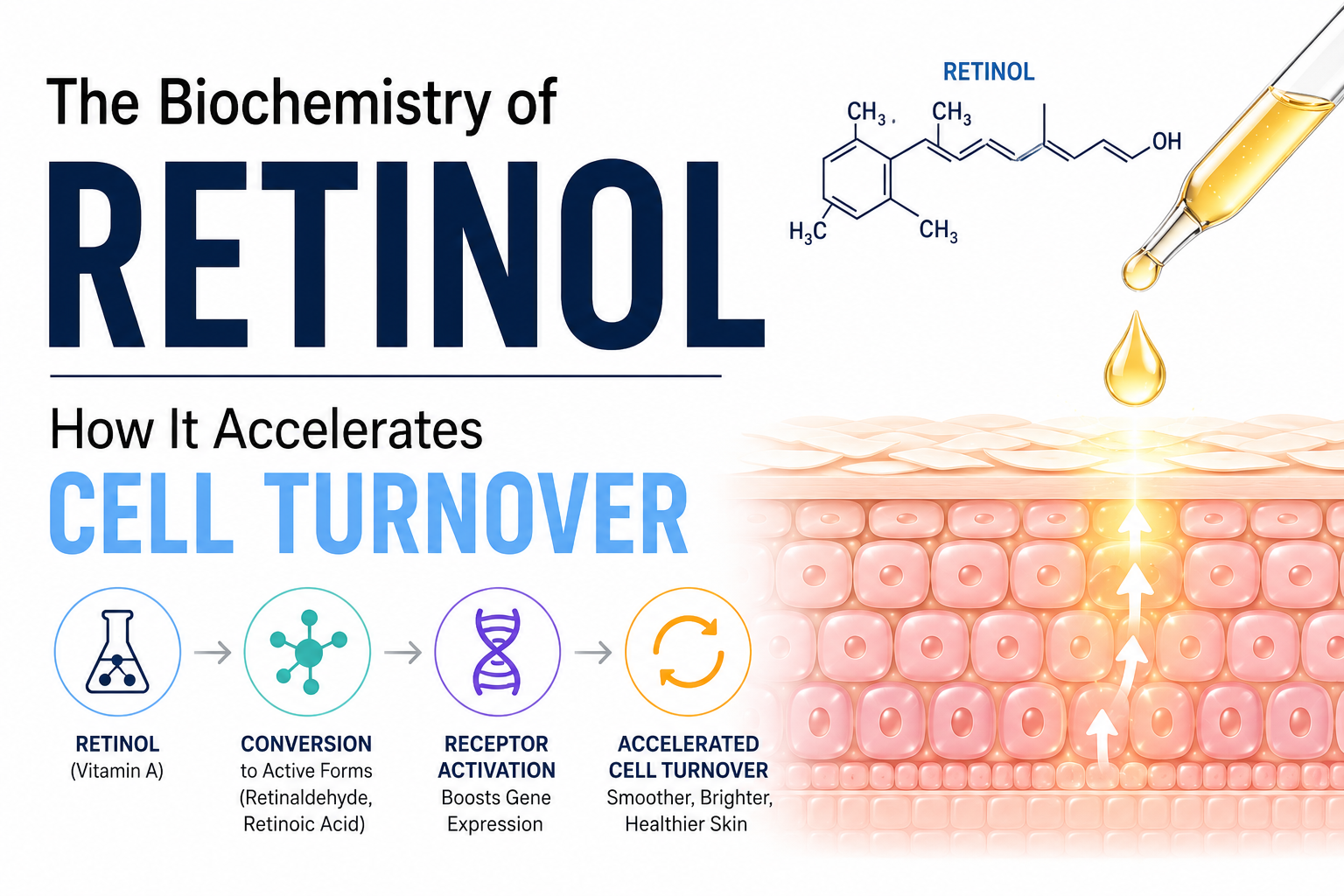
Retinol is a derivative of Vitamin A, but applying it to the epidermis does not yield immediate biological activity. To exert its physiological effects, retinol must undergo a specific metabolic conversion process within the keratinocytes (skin cells).
When applied topically, enzymes in the skin must convert the molecule through a two-step oxidation pathway:
- Step 1: Retinol is oxidized into Retinaldehyde (Retinal).
- Step 2: Retinaldehyde is further oxidized into Retinoic Acid (Tretinoin).
Retinoic acid is the only biologically active form that the skin’s cellular receptors can directly utilize. Because retinol requires this two-step enzymatic conversion, it provides a controlled, sustained release of retinoic acid. This gradual conversion is highly strategic: it delivers profound structural benefits to the skin while minimizing the severe erythema (redness) and peeling often associated with direct retinoic acid application.
2. Receptor-Mediated Gene Expression: Reprogramming the Cell
Once converted into retinoic acid, the molecule penetrates the cell nucleus, acting essentially as a cellular signaling hormone.
Inside the nucleus, retinoic acid binds to specific protein receptors: Retinoic Acid Receptors (RARs) and Retinoid X Receptors (RXRs). This binding action acts as a physiological “switch,” directly influencing DNA transcription and up-regulating specific gene expressions.
By altering these genetic instructions, retinoic acid fundamentally changes cellular behavior. It commands the basal layer of the epidermis (the lowest layer where new cells are born) to accelerate mitosis—the process of cell division.
3. Accelerating Cell Turnover: The Exfoliation Paradox
The primary visual benefit of retinol is its profound impact on the epidermal turnover rate.
In a healthy young adult, the life cycle of a skin cell—from its genesis in the basal layer to its shedding at the stratum corneum—takes approximately 28 days. As we age, this cycle sluggishly extends to 40, 50, or even 60 days. This delayed turnover results in an accumulation of dead, keratinized cells, leading to a dull complexion, compromised barrier function, and textural irregularities.
By binding to the RAR and RXR receptors, retinol accelerates this sluggish cycle back to a youthful baseline.
- Upward Push: It forces older, hyperpigmented, and damaged cells to the surface faster.
- Desquamation: It weakens the lipid bonds holding dead cells together on the surface, promoting natural, microscopic exfoliation.
Unlike physical scrubs or harsh chemical acids (AHAs/BHAs) that remove dead skin from the “outside-in,” retinol works from the “inside-out.” It does not melt the surface layer; rather, it accelerates the biological engine of the skin, pushing fresh, healthy cells to the surface at an optimized rate.
4. Dermal Extracellular Matrix Remodeling
The biochemical ROI of retinol extends beyond the epidermis deep into the dermis. While accelerating surface turnover, retinoic acid simultaneously addresses the structural integrity of the skin.
- Inhibiting Matrix Metalloproteinases (MMPs): UV exposure triggers the release of MMPs—enzymes that aggressively degrade existing collagen and elastin. Retinol effectively suppresses MMP activity, halting the breakdown of the skin’s structural scaffolding.
- Stimulating Fibroblasts: Simultaneously, retinol signals dermal fibroblasts to synthesize new Type I and Type III collagen, alongside hyaluronic acid. This dual action—preventing degradation while stimulating neo-collagenesis—is what clinically reduces the depth of fine lines and wrinkles.
5. Formulation Science: The Stability Challenge
From a product development and business perspective, retinol is notoriously difficult to formulate. It is a highly unstable molecule that degrades rapidly upon exposure to light, oxygen, and heavy metals.
To ensure the active ingredient remains viable from the laboratory to the consumer’s skin, advanced cosmetic chemistry relies on encapsulation technology. By housing the retinol molecule within liposomes or polymeric microcapsules, formulators can protect the compound from oxidation, improve its shelf-life, and enhance its targeted delivery deep into the dermal layers without premature degradation.
Conclusion: A Long-Term Biological Investment
The biochemistry of retinol proves that it is not a cosmetic quick fix, but a long-term physiological intervention. It literally rewrites the operational tempo of the skin. For professionals looking to optimize a skincare regimen, retinol offers unparalleled, scientifically validated returns. Understanding its conversion pathway and cellular signaling mechanisms allows for a more strategic, patient, and ultimately successful approach to clinical skin health.