How Urban Pollution Accelerates Skin Aging: Clinical Mechanisms and Antioxidant Defense Protocols
Executive Summary
Historically, the dermatological and cosmetic industries have focused almost exclusively on ultraviolet (UV) radiation as the primary driver of extrinsic skin aging. However, modern clinical research has identified a compounding, equally destructive environmental vector: urban pollution. As global urbanization intensifies, exposure to particulate matter, volatile organic compounds, and heavy metals is accelerating dermal degradation at an unprecedented rate. For skincare formulators, dermatologists, and urban professionals, understanding the biochemical pathology of pollution-induced aging—and implementing targeted antioxidant defense protocols—is no longer a secondary concern, but a fundamental requirement for comprehensive skin health.
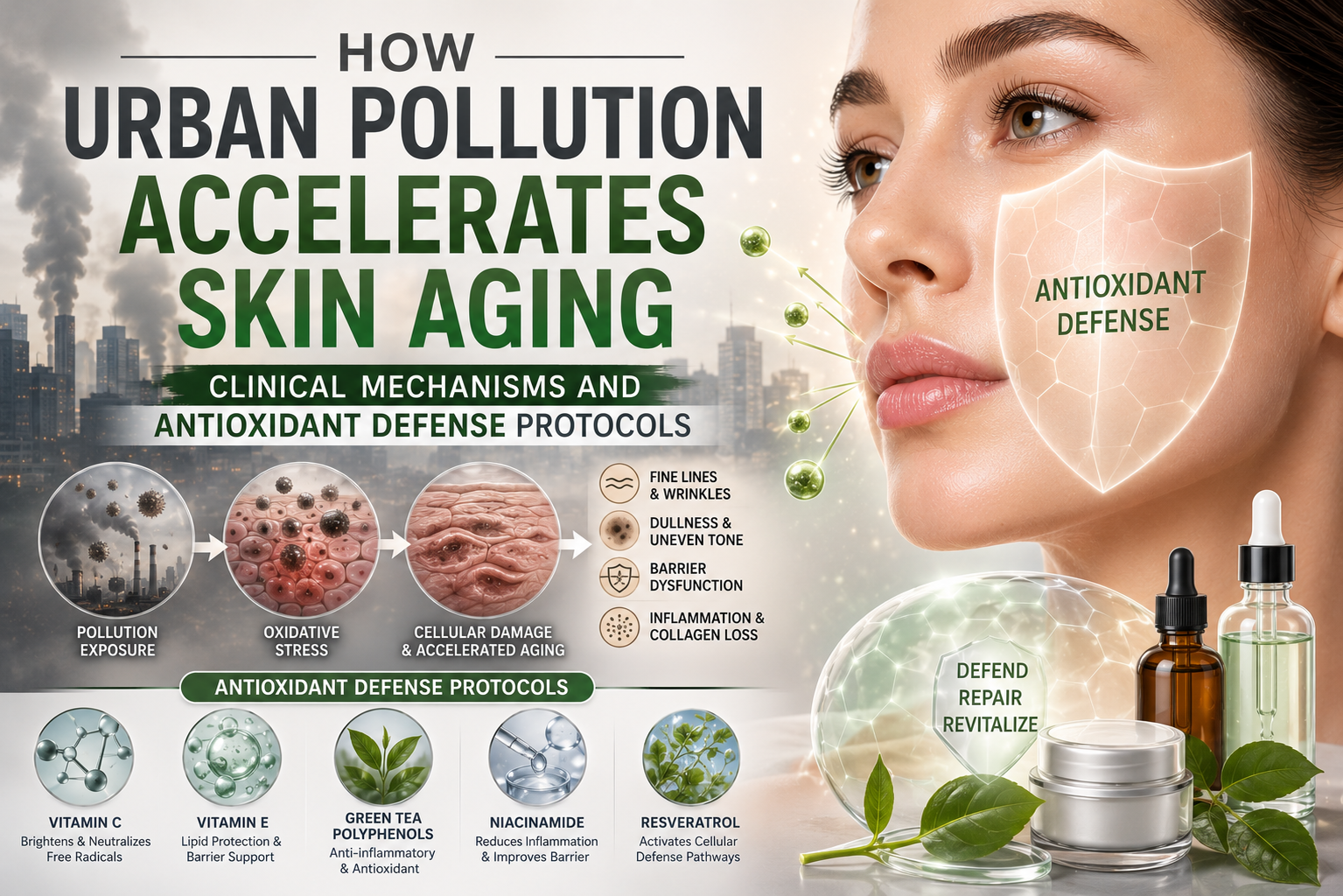
The Invisible Threat: Decoding Urban Pollutants
Urban pollution is not a monolith; it is a complex, highly reactive cocktail of atmospheric chemicals. To understand how it ages the skin, one must first identify the primary offenders:
- Particulate Matter (PM2.5 and PM10): These are microscopic particles of soot, dust, and smoke. PM2.5 (particles smaller than 2.5 micrometers) is particularly insidious because it is up to 20 times smaller than human pores, allowing it to easily infiltrate the stratum corneum through hair follicles and sweat glands.
- Polycyclic Aromatic Hydrocarbons (PAHs): Often bound to particulate matter, PAHs are highly lipophilic (fat-loving) chemicals generated by vehicle exhaust and industrial emissions. They readily dissolve into the skin’s natural lipid barrier.
- Ground-Level Ozone (O3): Unlike the protective ozone layer in the stratosphere, ground-level ozone is formed when pollutants react with sunlight. It strips the epidermis of its natural antioxidants.
The Biological Mechanism: Oxidative Stress and Matrix Breakdown
The destruction caused by pollution occurs primarily through a chain reaction known as oxidative stress.
When pollutants breach the skin barrier, they generate Reactive Oxygen Species (ROS), commonly known as free radicals. Free radicals are highly unstable molecules missing an electron. To stabilize themselves, they aggressively steal electrons from healthy cellular structures—including cell membranes, DNA, and structural proteins.
This biochemical theft triggers two catastrophic events for youthful skin:
- Lipid Peroxidation: Free radicals oxidize the squalene and ceramides in the skin barrier, turning healthy sebum into a comedogenic, inflammatory irritant.
- MMP Activation: Oxidative stress signals the overproduction of Matrix Metalloproteinases (MMPs), specific enzymes whose sole biological function is to break down collagen and elastin. Consequently, the structural matrix of the dermis physically collapses.
Clinical Manifestations of Pollutant-Induced Aging
The cumulative effect of urban pollution manifests in distinct clinical signs that differentiate it from standard photoaging.
| Clinical Sign | Biological Driver | Visible Result |
| Lentigines (Dark Spots) | PAHs activate melanocytes, triggering excess melanin production as a stress response. | Pronounced, stubborn hyperpigmentation, particularly on the cheeks. |
| Loss of Elasticity | MMPs systematically degrade collagen and elastin fibers in the deep dermis. | Premature sagging, widened pores, and deep-set wrinkles. |
| Barrier Dysfunction | Lipid peroxidation destroys the protective stratum corneum. | Chronic dehydration, redness, and heightened sensitivity to benign products. |
| Asphyxiated Skin | Micro-particles trap debris and oxidize sebum within the pores. | A dull, sallow complexion with frequent micro-comedonal breakouts. |
The Antioxidant Arsenal: Neutralizing the Threat
If free radicals are the biological saboteurs, antioxidants are the ultimate defense mechanism. Antioxidants are uniquely structured molecules capable of donating an electron to a free radical without becoming unstable themselves. By neutralizing the ROS before they can attack healthy cells, antioxidants halt the cascade of oxidative stress and prevent MMP-induced collagen degradation.
To effectively combat urban pollution, a multi-faceted antioxidant strategy is required:
- L-Ascorbic Acid (Vitamin C): The gold standard for aqueous (water-soluble) protection. It neutralizes free radicals in the cellular fluid, inhibits the overproduction of melanin, and is essential for the synthesis of new collagen.
- Tocopherol (Vitamin E): A lipophilic (fat-soluble) antioxidant that specifically protects cell membranes and the skin’s lipid barrier from lipid peroxidation.
- Ferulic Acid: A plant-based antioxidant that, when formulated with Vitamins C and E, exponentially increases their photoprotective capabilities and stabilizes the overall formulation.
- Niacinamide (Vitamin B3): While technically a cell-communicating ingredient, it acts as a powerful secondary defense by stimulating ceramide production to physically block particulate matter from entering the skin.
Strategic Integration: The Anti-Pollution Protocol
For consumers navigating high-density urban environments, utilizing antioxidants requires strategic application. The optimal protocol operates on three fronts:
- The Morning Shield: Apply a high-potency, multi-antioxidant serum (e.g., a Vitamin C, E, and Ferulic Acid complex) directly after cleansing. This saturates the skin’s defense reserves before exposure to the day’s ozone and exhaust. Follow immediately with a broad-spectrum physical sunscreen to seal the active ingredients and deflect UV-catalyzed pollution reactions.
- The Evening Extraction: Urban pollution cannot simply be washed off with water. A meticulous “double cleanse” is mandatory. First, utilize an oil-based cleanser or balm to dissolve lipophilic PAHs and oxidized sebum, followed by a gentle, low-pH water-based cleanser to remove sweat and water-soluble debris.
- Nocturnal Barrier Repair: The evening routine must focus on restoring the damaged lipid matrix. Nighttime applications should feature barrier-fortifying ingredients like ceramides, peptides, and humectants to repair the micro-tears caused by particulate matter.
Conclusion: The Future of Preventative Dermatology
In the modern era, anti-aging skincare that ignores environmental pollution is fundamentally incomplete. The clinical data is unequivocal: particulate matter and volatile organic compounds actively dismantle the cellular architecture of the skin. For industry professionals designing product lines and urbanites investing in their long-term skin health, the daily, strategic application of stabilized antioxidants is no longer an optional luxury. It is an essential, evidence-based shield against the realities of the modern environment.