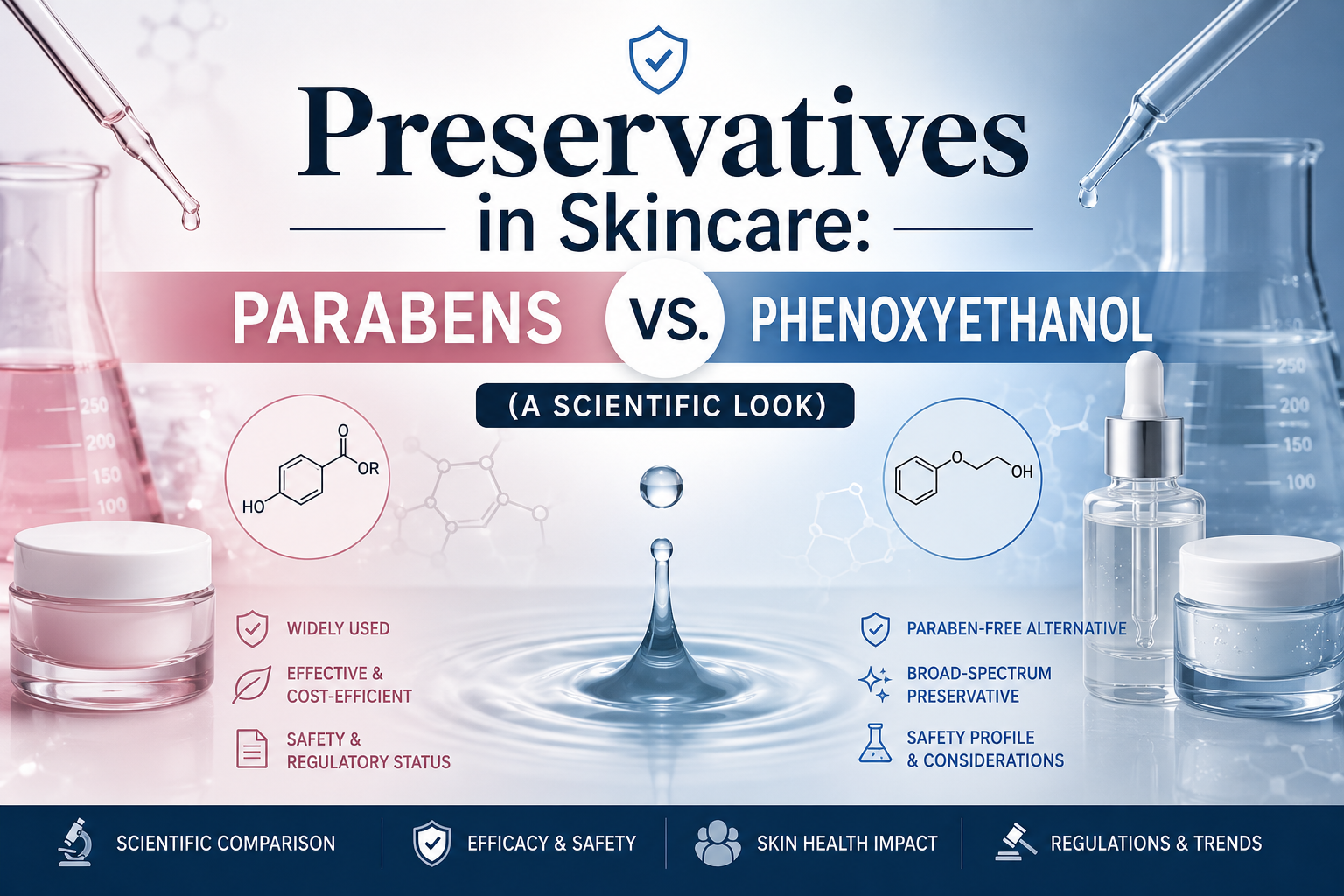
Preservatives in Skincare: Parabens vs. Phenoxyethanol (A Scientific Look)
In the modern cosmetic marketplace, formulation decisions are no longer confined to the laboratory. They are heavily litigated in the court of public opinion. Among these, few topics ignite as much debate as cosmetic preservation.
Every aqueous (water-based) skincare product is a fertile breeding ground for microbial life. Without robust preservation, a premium serum turns into a biohazard within days. For brands and R&D executives, selecting a preservative system requires balancing uncompromising microbiological safety, chemical stability, regulatory compliance, and consumer sentiment.
This column provides a rigorous scientific analysis of the industry’s two most talked-about preservative groups: Parabens and Phenoxyethanol.
1. The Critical Imperative of Cosmetic Preservation
To understand the value of these compounds, one must look at the mathematical reality of microbial growth. In a formulation with high water activity ($a_w$), a single Pseudomonas aeruginosa bacterium can replicate into millions within hours.
Preservatives are not optional aesthetic additives; they are fundamental safety barriers that protect consumers from severe pathogenic infections, corneal damage, and skin irritation. An effective preservative system must display broad-spectrum efficacy, meaning it can simultaneously inhibit:
- Gram-positive bacteria (Staphylococcus aureus)
- Gram-negative bacteria (Pseudomonas aeruginosa)
- Molds and Yeasts (Aspergillus niger, Candida albicans)
2. Parabens: The Legacy Gold Standard Under Siege
Parabens are a family of alkyl esters of $p$-hydroxybenzoic acid, including Methylparaben, Ethylparaben, Propylparaben, and Butylparaben. For over half a century, they reigned as the gold standard of cosmetic preservation.
HO — [ Benzene Ring ] — COO — R (Alkyl Group)
The Science of Efficacy
Parabens disrupt the cytoplasmic membrane of microorganisms and inhibit mitochondrial electron transport chain enzymes.
- The Formulation Advantage: They are incredibly broad-spectrum, exceptionally stable across a wide pH range (4.5 to 8.0), global regulatory approved, highly cost-effective, and completely odorless.
The Regulatory and Consumer Backlash
The decline of parabens was not triggered by laboratory failure, but by a 2004 study by Dr. Philippa Darbre, which detected paraben molecules in human breast tumor tissue.
Scientific Reality Check: The 2004 study lacked a control group, did not measure paraben levels in healthy tissue, and failed to prove that parabens cause cancer. Furthermore, while parabens can mimic estrogen in vitro, their actual in vivo endocrine-disrupting potency is up to 100,000 times weaker than natural human estrogen.
Despite unconditional safety clearances from the SCCS (Scientific Committee on Consumer Safety) and the CIR (Cosmetic Ingredient Review) for short-chain parabens (Methyl and Ethyl), consumer anxiety forced a massive industry migration away from them, giving rise to the “Paraben-Free” marketing paradigm.
3. Phenoxyethanol: The Modern Market Successor
As brands scrambled to replace parabens, Phenoxyethanol—an aromatic ether alcohol—emerged as the primary beneficiary of the clean beauty movement.
The Mechanism of Action
Phenoxyethanol functions by increasing the permeability of the microbial cell membrane, causing vital cellular components to leak out and effectively uncoupling the cell’s energy-producing proton pumps.
- The Spectrum Gap: Phenoxyethanol is exceptionally proficient at destroying Gram-negative bacteria. However, it exhibits weaker efficacy against molds and yeasts.
- The Synergy Solution: Because it is not a perfect standalone solution, cosmetic chemists rarely use Phenoxyethanol in isolation. It is systematically paired with booster ingredients—most commonly Ethylhexylglycerin or Caprylyl Glycol—which break down microbial cell walls, allowing Phenoxyethanol to penetrate and neutralize the organism more efficiently.
Safety Profile and Limitations
Phenoxyethanol boasts an excellent safety track record in adults. However, it is restricted globally (including by the EU and the FDA) to a maximum concentration of 1.0% in cosmetic formulations.
While highly stable in heat and across a broad pH spectrum (3.0 to 12.0), it does carry formulation hurdles. It can destabilize certain acrylic-based thickeners, requiring formulators to carefully adjust rheology modifiers to prevent emulsion splitting.
4. Head-to-Head Comparative Matrix
To guide strategic R&D decisions, the table below highlights the operational tradeoffs between these two preservative technologies:
| Metric | Parabens (Methyl/Ethyl) | Phenoxyethanol Blend |
| Microbial Spectrum | Superior Broad-Spectrum (Standalone) | Strong vs. Bacteria; Requires synergistic booster for Fungi |
| pH Stability Range | 4.5 – 8.0 | 3.0 – 12.0 (Highly versatile) |
| Regulatory Threshold | Approved (Up to 0.4% individually / 0.8% total) | Approved globally up to a strict 1.0% cap |
| Sensory/Odor Profile | Odorless; Neutral impact on formula | Mild rose-like chemical odor; can alter fragrance profile |
| Market/Consumer Perception | Heavily stigmatized by “Clean Beauty” | Widely accepted; default substitute for mass/prestige |
Conclusion: The Strategic Future of Preservation
From a purely objective, microbiological standpoint, parabens remain one of the safest, most stable, and most efficient preservative groups ever discovered. However, in the commercial beauty space, consumer perception is commercial reality.
For modern brands, Phenoxyethanol boosted by modern glycols represents the most viable, regulatory-compliant compromise between clinical safety and consumer acceptance.
Looking forward, the cosmetic industry is moving toward “Hurdle Technology”—combining low-dose preservation with multifunctional ingredients, chelating agents, and airless packaging to minimize reliance on any single traditional preservative molecule. Ultimately, the goal remains unchanged: ensuring that advanced skincare science is delivered in a pristine, uncompromised, and sterile vehicle.