The Formulation Science Behind Mineral vs. Chemical Sunscreens: A Market & R&D Perspective
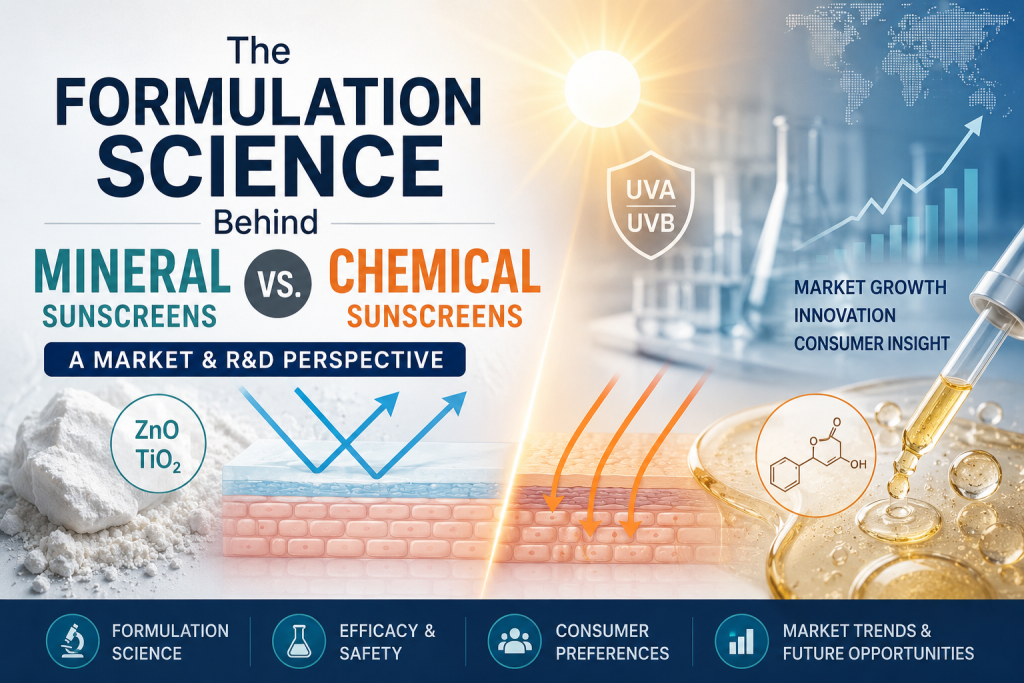
The global sun care market is undergoing a profound paradigm shift. No longer viewed as merely seasonal vacation products, sunscreens have integrated deeply into daily skincare routines, driven by anti-aging trends and heightened dermatological awareness. For brands, R&D departments, and market strategists, understanding the underlying formulation science of Ultraviolet (UV) filters is no longer just a technical requirement—it is a core business advantage.
At the heart of product development lies the definitive choice between two distinct mechanisms: Mineral (Physical) and Chemical (Organic) filters. This column analyzes the molecular science, formulation hurdles, and shifting regulatory landscapes that define these two pillars of sun protection.
1. The Molecular Blueprint: Mechanism of Action
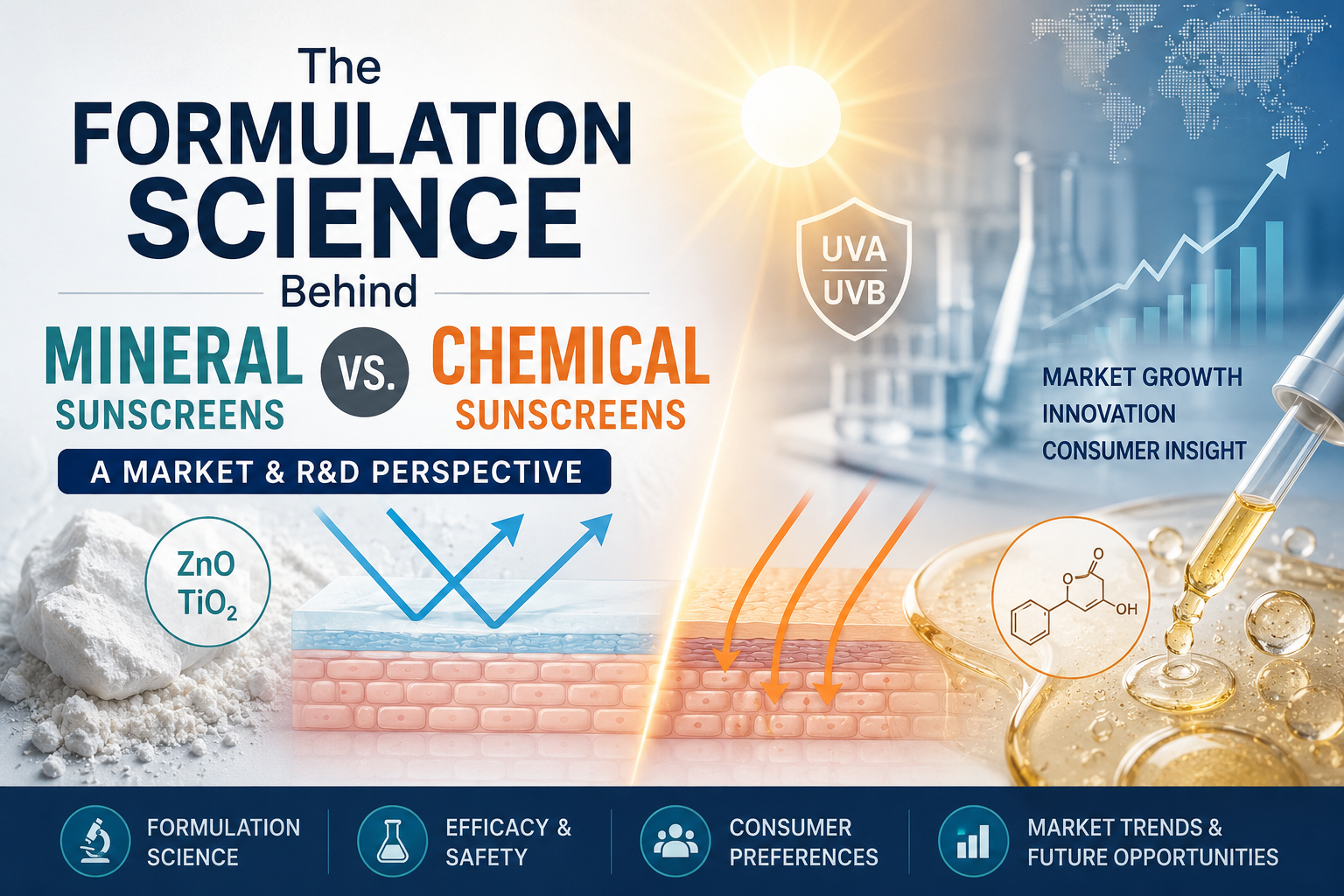
To engineer an effective Broad-Spectrum SPF product, formulators must first decide how the formulation will interact with solar radiation at a molecular level.
[Solar Radiation (UVA/UVB)]
       │
       ├─► (Mineral Filter: ZnO/TiO2) ──► Reflection & Scattering (~5-10%) + Absorption (~90-95%)
       │
       └─► (Chemical Filter: Avobenzone) ─► Chemical Absorption ──► Thermal Energy Dissipation
Mineral Filters: Scattering and Absorption
Mineral sunscreens rely on inorganic metal oxides—primarily Zinc Oxide ($ZnO$) and Titanium Dioxide ($TiO_2$). Historically categorized as pure physical blockers that reflect light like a mirror, modern cosmetic chemistry reveals a more nuanced reality:
- Mechanism: While they do scatter and reflect a small percentage of visible and UV light, modern microfine or nano-mineral particles actually protect skin primarily through absorption, converting UV radiation into harmless heat.
- Spectrum Coverage: Zinc Oxide is highly prized for its exceptional broad-spectrum capability, uniformly covering both UVA (aging) and UVB (burning) wavelengths. Titanium Dioxide is highly efficient against UVB but less effective against long-wave UVA1.
Chemical Filters: The Quantum Absorption Layer
Chemical sunscreens utilize organic, carbon-based compounds such as Avobenzone, Octinoxate, Oxybenzone, and next-generation molecules like Tinosorb and Mexoryl.
- Mechanism: These molecules feature conjugated chemical bonds that absorb high-energy UV photons. Upon absorption, the electrons enter an excited state. As they return to their ground state, they release the captured energy safely as low-energy thermal radiation (heat).
- Spectrum Coverage: Achieving broad-spectrum protection with traditional chemical filters requires a strategic cocktail of different ingredients, as individual organic molecules typically target narrow bands of the UV spectrum.
2. The Formulator’s Dilemma: Rheology, Aesthetics, and Stability
Choosing an active ingredient is only the first step. Translating that choice into a commercially viable, elegant emulsion requires overcoming significant formulation hurdles.
Challenges in Mineral Formulations: The War on White Cast
The primary barrier to consumer adoption of mineral sunscreens is the notorious “white cast.” Because metal oxides have a high refractive index, they naturally scatter visible light, appearing white on the skin.
- Particle Size Engineering: Formulators mitigate this by utilizing micronized or nano-sized particles (approx. 15–50 nm). While this drastically improves transparency, it increases particle surface energy, causing them to agglomerate.
- Dispersion and Rheology: If mineral particles clump together, the SPF efficacy drops drastically. Formulators must employ specialized surface treatments (such as silicone or fatty acid coatings) and high-shear mixing to ensure a stable, homogeneous dispersion within the emulsion.
Challenges in Chemical Formulations: The Photo-Stability Conundrum
While chemical sunscreens offer unparalleled cosmetic elegance—leaving a weightless, invisible finish—they face a critical vulnerability: photo-degradation.
- The Avobenzone Vulnerability: Avobenzone is the gold standard for UVA protection in many markets, yet it is notoriously unstable. Exposure to UV light causes its molecular structure to break down rapidly, losing up to 36% of its efficacy within an hour of sun exposure.
- Stabilization Matrices: To counteract this, cosmetic chemists must introduce stabilizing co-solvents and photostabilizers like Octocrylene or Bemotrizinol (Tinosorb S). Crafting a stable chemical sunscreen is a delicate balancing act of molecular puzzle pieces.
3. Regulatory Paradigms and Environmental Compliance
The choice between mineral and chemical formulations is heavily dictated by geography and shifting global compliance standards.
| Factor | Mineral Sunscreens (ZnO / TiO2) | Chemical Sunscreens (Organic Filters) |
| FDA Status (USA) | Generally Recognized as Safe & Effective (GRASE) | Under scrutiny; pending further safety data |
| EU Status | Approved (including Nano forms with restrictions) | Widely approved; features advanced filters (Tinosorb/Mexoryl) |
| Environmental Impact | Deemed “Reef-Safe” (Non-nano forms favored) | Certain filters (Oxybenzone/Octinoxate) banned in tourist hubs |
| Sensory Profile | Tends to be heavier; prone to matting or drying | Lightweight; transparent; luxury skincare aesthetic |
The FDA vs. European Union Divergence
The regulatory landscape behaves like two entirely different markets. The US FDA treats sunscreens as Over-The-Counter (OTC) drugs, meaning new filter approvals have stalled for decades. Currently, only Zinc Oxide and Titanium Dioxide are unconditionally recognized as GRASE (Generally Recognized as Safe and Effective).
Conversely, the European Union regulates sunscreens as cosmetics, granting formulators access to over 30 UV filters. This includes highly efficient, photostable, large-molecule chemical filters that offer superior safety profiles because they do not penetrate the stratum corneum.
The Clean Beauty and “Reef-Safe” Movement
Environmental consumerism has profoundly impacted R&D pipelines. Studies indicating that traditional chemical filters like Oxybenzone and Octinoxate contribute to coral bleaching have led to legislative bans in regions like Hawaii, Key West, and Thailand. This has triggered a massive market pivot toward “Reef-Safe” non-nano mineral formulations, establishing a lucrative premium sector within the prestige beauty market.
Conclusion: The Strategic Future of Sun Care
As consumer expectations converge on products that deliver both flawless aesthetics and uncompromising safety, the line between mineral and chemical sunscreens is blurring. The future of sun care formulation lies in hybrid systems—marrying the immediate, non-irritating protection of mineral blocks with the lightweight, transparent finish of organic absorbers.
Furthermore, encapsulation technologies are paving the way for chemical filters to be enclosed in silica beads, preventing direct skin contact and minimizing sensitivity while preserving their lightweight sensory properties.
For brand executives and product innovators, navigating the science behind these formulations is the ultimate key to capturing market share in an increasingly sophisticated, skin-conscious global economy.